

The Twelve Apostles: A Comprehensive Overview
Exploring the lives and personalities of Jesus’s twelve chosen disciples reveals a diverse group. From Simon Peter’s leadership to Judas Iscariot’s betrayal, each apostle possessed unique traits, documented in various resources, including downloadable PDFs detailing their individual characteristics.

The twelve apostles represent a cornerstone of Christian faith, serving as the initial messengers of Jesus Christ’s teachings. Chosen from diverse backgrounds – fishermen, tax collectors, and zealots – their selection underscores a message of inclusivity and divine purpose. Understanding their individual characteristics provides invaluable insight into the early Church and the spread of the Gospel.
Numerous resources, including comprehensive PDFs, delve into the personalities and roles of each apostle. These materials often highlight Simon Peter’s assertive leadership, frequently mentioned throughout the New Testament, and the fiery zeal of James and John, aptly nicknamed “Sons of Thunder.” Conversely, figures like Bartholomew (Nathanael) are noted for their honesty, while Thomas is remembered as “the doubter,” ultimately affirming his faith after witnessing the resurrected Christ.
Exploring these profiles reveals not only biographical details but also potential psychological archetypes, as suggested by Jungian interpretations found online. The apostles weren’t simply historical figures; they were complex individuals whose strengths and weaknesses shaped their contributions to the nascent Christian movement. PDF documents and online articles offer detailed analyses, mapping these apostles to personality frameworks for a deeper understanding.
Simon Peter: The Foundation
Simon, later known as Peter – meaning “rock” – is arguably the most prominent of the twelve apostles. Numerous biblical accounts and supplementary PDFs emphasize his pivotal role in the early Christian community, often identifying him as the leader amongst the disciples due to his outspoken and assertive nature. His name appears more frequently than any other apostle in the Gospels.
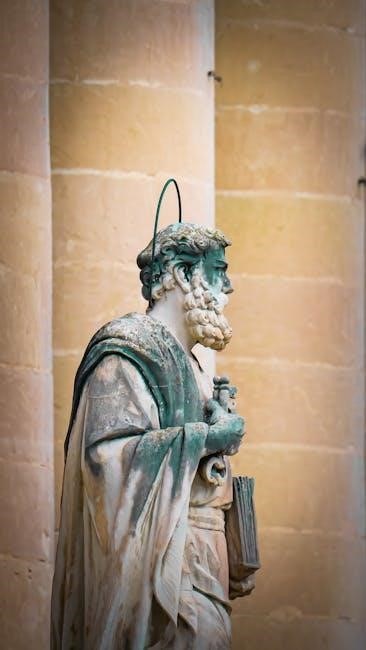
Initially a fisherman, Peter’s impetuous character is evident in his eagerness, yet also his moments of doubt and denial. He boldly proclaimed Jesus as the Messiah, yet famously denied knowing Him three times before the crucifixion. However, his subsequent repentance and unwavering loyalty solidified his position as a foundational figure.
PDF resources dedicated to the apostles often detail Peter’s post-resurrection leadership, highlighting his powerful sermons and crucial role in establishing the Church. He’s considered the first Pope by Catholic tradition. Analyses explore his transformation from a flawed individual to a steadfast pillar of faith, demonstrating the power of redemption and divine grace. His story serves as a powerful example of leadership forged through both strength and vulnerability.
Andrew: The First Called
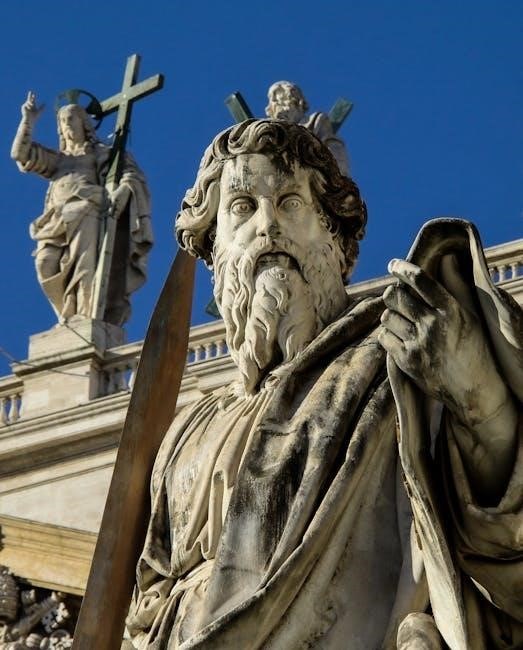
Andrew, brother of Simon Peter, holds the distinction of being one of the very first disciples called by Jesus. Often overshadowed by his more vocal brother, Andrew’s character is described as one of quiet dedication and enthusiastic introduction. He is noted for immediately seeking out his brother, Simon, to share the momentous news of encountering the Messiah.
PDF studies focusing on the apostles frequently highlight Andrew’s role as a bridge-builder, connecting others to Jesus. While not as prominently featured in the Gospels as some others, his initial act of bringing his brother demonstrates a proactive faith and a desire to share the good news. This characteristic is often linked to the meaning of his name, which signifies “manly” or “strong.”
Some interpretations, explored in online resources and downloadable materials, connect Andrew to the concept of strength – not necessarily in a boisterous way, but in a steadfast commitment to his faith. He represents the power of initial encounter and the immediate impulse to share transformative experiences. His story emphasizes the importance of simple faith and the ripple effect of discipleship.
James the Greater: Fiery Zeal
James, the son of Zebedee, alongside his brother John, was among the first disciples called by Jesus. He’s often referred to as “James the Greater” to distinguish him from James the Lesser. A defining characteristic of James was his intense, almost impulsive, zeal – a fiery passion for his faith and a quickness to action.
Numerous resources, including detailed apostle characteristic PDFs, point to instances demonstrating this zeal. Notably, James and John earned the nickname “Sons of Thunder” from Jesus, likely due to their passionate, and sometimes rash, reactions. One account details their desire to call down fire upon a Samaritan village that refused to offer hospitality to Jesus, showcasing their protective fervor.
However, this zeal wasn’t merely aggressive; it also manifested as unwavering dedication. James was present at key moments in Jesus’s ministry, including the Transfiguration. Studies suggest his fiery nature, while sometimes needing tempering, ultimately fueled a profound commitment to spreading the Gospel. His story serves as a reminder that passion, when channeled correctly, can be a powerful force for faith.
John the Apostle: The Apostle of Love
John, brother of James the Greater, is uniquely recognized as “the Apostle of Love.” While initially sharing his brother’s “Sons of Thunder” designation – indicative of a fiery temperament – John’s legacy evolved to embody compassion and profound affection for both Jesus and fellow believers. Apostle characteristic PDFs frequently highlight this transformation.
This shift is largely attributed to his authorship of the Gospel of John, three epistles (1, 2, and 3 John), and the Book of Revelation. These writings consistently emphasize the theme of love – God’s love for humanity and the reciprocal love believers should have for one another. His Gospel presents Jesus as the ultimate expression of divine love.
Interestingly, despite his initial impulsiveness, John became known for his gentle and nurturing spirit in later life. Church tradition portrays him as a beloved figure, offering guidance and care to the early Christian community. His writings continue to inspire countless individuals to embrace a life centered on love, forgiveness, and unwavering faith, solidifying his title as the Apostle of Love.
Philip: The Practical Disciple
Philip, hailing from Bethsaida, is often characterized as the practical and down-to-earth disciple. Unlike some of his more zealous counterparts, Philip approached faith with a thoughtful and pragmatic mindset. Apostle characteristics PDFs often describe him as a realist, focused on tangible needs and logistical considerations.
The Gospel of John portrays Philip as the apostle who brought Nathanael to Jesus, demonstrating his willingness to share his faith with others. He’s also depicted as the one who inquired about how Jesus would feed the large crowd with only a small amount of money, a very practical concern. This highlights his grounded nature and attention to detail.
While not as prominently featured as Peter or John, Philip’s role was crucial in connecting people to Jesus. He wasn’t prone to grand pronouncements or impulsive actions, but rather, he consistently demonstrated a quiet, steadfast faith. His practicality and willingness to engage with real-world problems make him a relatable and often overlooked figure among the twelve, a point often detailed in comprehensive apostle studies.
Bartholomew (Nathanael): Honest and Open
Bartholomew, widely believed to be the same individual as Nathanael, stands out for his remarkable honesty and initial skepticism towards Jesus. Apostle characteristics PDFs frequently emphasize his directness and lack of pretense, qualities revealed in his first encounter with Jesus as recounted in the Gospel of John.
Nathanael initially questioned whether anything good could come from Nazareth, expressing his doubts openly. However, upon meeting Jesus, he was profoundly moved by Jesus’s knowledge of him – “Rabbi, you are the Son of God! You are the King of Israel!” – demonstrating a willingness to change his mind when confronted with truth.
This initial skepticism, followed by fervent belief, defines Nathanael/Bartholomew’s character. He wasn’t afraid to voice his opinions, even if they were critical, and possessed a genuine desire for authenticity. His story serves as a powerful reminder that honest questioning can lead to deeper faith, a theme often explored in detailed analyses of the apostles’ personalities and backgrounds.
Thomas: The Doubter

Thomas, often remembered as “Doubting Thomas,” embodies the archetype of the skeptic within the group of twelve apostles. Apostle characteristics PDFs consistently highlight his demand for empirical evidence – he famously refused to believe in Jesus’s resurrection until he could physically touch the wounds from the crucifixion.
This isn’t necessarily a mark of weakness, but rather a testament to Thomas’s practical nature and need for concrete proof. He wasn’t easily swayed by hearsay or emotional appeals. His doubt, while initially hindering his immediate acceptance of the resurrection, ultimately led to a powerful affirmation of faith when Jesus appeared to him and invited him to touch his wounds.
Many interpretations suggest Thomas’s skepticism wasn’t born of disbelief, but a deep-seated desire to fully understand the miraculous event. His eventual declaration, “My Lord and my God!” is considered a profound expression of faith, demonstrating that even doubt can be a pathway to unwavering belief. Detailed studies often portray Thomas as a rational thinker who required tangible evidence to embrace the extraordinary.
Matthew (Levi): The Tax Collector
Matthew, also known as Levi, presents a compelling story of transformation within the ranks of the twelve apostles. Apostle characteristics PDFs frequently emphasize his prior profession as a tax collector – a deeply unpopular and often despised role in first-century Judea, associated with collaboration with the Roman authorities and perceived dishonesty.
His inclusion among Jesus’s disciples was therefore quite radical, challenging societal norms and demonstrating Jesus’s willingness to embrace those considered outcasts. Matthew’s background likely provided him with organizational skills and a meticulous attention to detail, qualities that may have contributed to his authorship of the Gospel bearing his name.
The Gospel of Matthew is noted for its structured presentation and emphasis on Jesus as the fulfillment of Old Testament prophecies. This suggests a thoughtful and analytical mind. His transition from a position of societal rejection to becoming a key figure in the early church highlights the power of redemption and the inclusive nature of Jesus’s message. Resources often portray Matthew as a bridge between Jewish tradition and the emerging Christian faith.
James the Lesser: Humble Service
James the Lesser, often identified as James, son of Alphaeus, remains a somewhat enigmatic figure among the twelve apostles. Apostle characteristics PDFs often note the relative scarcity of information about him in the Gospels compared to other disciples. This lack of extensive detail contributes to a perception of quiet humility and unassuming dedication.
He is frequently mentioned in lists of the apostles, indicating his consistent presence within Jesus’s inner circle, yet his individual contributions are less prominently featured in biblical narratives. Some traditions associate him with James, the brother of Jesus, and a leader in the Jerusalem church, suggesting a continued commitment to service after the Ascension.

His designation as “the Lesser” likely distinguishes him from James the Greater, son of Zebedee, and doesn’t necessarily imply any deficiency in faith or importance. Instead, it highlights a different style of discipleship – one characterized by quiet faithfulness and a willingness to serve without seeking the spotlight. Resources often portray James the Lesser as embodying the virtue of unassuming devotion to Christ and the early church.
Thaddaeus (Judas, son of James): Less Known Apostle
Thaddaeus, also known as Judas son of James, is arguably one of the most obscure figures among the twelve apostles. Apostle characteristics PDFs consistently acknowledge the limited biblical information available about him, contributing to his relative anonymity. He’s often listed among the apostles, but rarely features in detailed narratives of Jesus’s ministry.
Distinguishing him from Judas Iscariot is crucial, as the shared name often causes confusion. Biblical texts offer little insight into his personality or specific role within the apostolic group. Some traditions suggest he may have been a relative of Jesus, further complicating his historical identification.
Despite the lack of extensive documentation, his inclusion among the chosen twelve signifies his importance in God’s plan. He faithfully followed Jesus, witnessing his teachings, miracles, and ultimately, his crucifixion and resurrection. Resources emphasize that even the “less known” apostles played a vital role in establishing the early church, demonstrating that faithfulness isn’t contingent upon prominence or extensive biographical detail.
Simon the Zealot: Former Revolutionary
Simon, identified as “the Zealot,” presents a fascinating contrast within the apostolic circle. Apostle characteristics PDFs highlight his prior affiliation with a politically motivated Jewish movement fiercely opposed to Roman rule. The Zealots advocated for Jewish independence through active resistance, sometimes employing violent tactics – a stark background for a disciple of the Prince of Peace.

His inclusion among Jesus’s followers is particularly striking, suggesting a profound transformation. It demonstrates Jesus’s ability to reach and redeem individuals from vastly different ideological and social backgrounds. The very name “Zealot” implies a passionate, dedicated nature, qualities that, once redirected, could be powerfully channeled into spreading the Gospel.
While the Bible offers limited details about Simon’s personality or specific contributions, his past suggests a man of strong convictions and unwavering commitment. His story serves as a powerful reminder that even those with a history of radicalism or opposition can find purpose and belonging within the Christian faith, embodying a complete life change.
Judas Iscariot: The Betrayer
Judas Iscariot remains the most infamous of the twelve apostles, forever branded as the betrayer. Apostle characteristics PDFs often dedicate significant attention to understanding the motivations behind his actions, though definitive answers remain elusive. He was entrusted with the common fund, suggesting a degree of initial trust from Jesus and the other disciples.
However, Scripture reveals a growing discontent and ultimately, a plot to hand Jesus over to the authorities for thirty pieces of silver. Theories abound regarding his motives – greed, disillusionment with Jesus’s perceived lack of political ambition, or even a misguided attempt to force Jesus’s hand. Regardless, his betrayal paved the way for the crucifixion.
The tragic aftermath of Judas’s act – his remorse, followed by suicide – underscores the devastating consequences of his choice. His story serves as a cautionary tale about the dangers of pride, selfishness, and the corrosive power of sin. While vilified, Judas’s role, however painful, was foretold in prophecy, adding a layer of complexity to his narrative.

Apostolic Characteristics and Jungian Archetypes
Interestingly, explorations into the personalities of the twelve apostles extend beyond biblical accounts, with some scholars applying Carl Jung’s archetypes to understand their distinct roles. Apostle characteristics PDFs increasingly incorporate these psychological perspectives, offering a novel lens through which to view the disciples.
For example, Simon Peter embodies the ‘Hero’ archetype – assertive, courageous, and often impulsive. Andrew, representing ‘Strength,’ aligns with his name’s meaning. John, the ‘Apostle of Love,’ resonates with the ‘Caregiver’ archetype, displaying compassion and deep emotional connection. Thomas, the doubter, fits the ‘Skeptic’ archetype, demanding empirical evidence.
This framework suggests the deliberate composition of the group by Jesus, assembling individuals representing a spectrum of human traits. Applying Jungian psychology doesn’t diminish the spiritual significance but provides a richer understanding of their interactions and contributions. It allows for a more nuanced interpretation of their flaws and strengths, as documented in various analyses and downloadable resources.
The Apostles’ Roles After Jesus’ Ascension
Following Jesus’s ascension, the apostles embarked on a period of intense missionary work, spreading the Gospel and establishing early Christian communities. Apostle characteristics PDFs often detail their subsequent journeys and contributions to the burgeoning faith, highlighting how their individual traits shaped their evangelistic approaches.
Peter, initially a leader in Jerusalem, played a pivotal role in the early church’s growth, though his impetuous nature continued to surface. Paul, though not one of the original twelve, became a crucial apostle to the Gentiles. John, known for his love and compassion, authored several epistles and the Book of Revelation.
Many apostles faced persecution and martyrdom for their beliefs, demonstrating unwavering commitment. Their stories, documented in the New Testament and further explored in scholarly PDFs, illustrate the transformative power of faith. The apostles’ post-ascension roles weren’t simply continuations of their time with Jesus, but rather dynamic expansions fueled by their unique characteristics and the Holy Spirit’s guidance, solidifying their legacy.

Resources for Further Study (PDFs and Online Materials)
Numerous resources delve into the lives and characteristics of the twelve apostles, offering deeper insights beyond the biblical narrative. Several institutions and scholars provide downloadable PDFs analyzing their personalities, roles, and impact on early Christianity. Websites like Bible Gateway and Blue Letter Bible offer extensive commentaries and character studies.
For a Jungian perspective, exploring articles mapping the apostles to archetypes – as discussed on platforms like Reddit – can be illuminating. Britannica provides concise biographical information, while academic databases offer scholarly articles examining historical context and theological interpretations. Searching for “12 apostles characteristics pdf” yields a wealth of downloadable materials.
Additionally, resources from seminaries and theological colleges often include detailed analyses of each apostle’s unique contribution. Online forums, such as AskAChristian on Reddit, facilitate discussions and diverse viewpoints. These resources collectively paint a richer, more nuanced portrait of these foundational figures of the Christian faith, aiding comprehensive study.